

Home
Get started with Atono and keep track of the work that matters to you.
Your Home page is where you start your work in Atono. Its widgets keep track of the stories and bugs that matter to you, and until you dismiss it, an onboarding panel introduces the features most relevant to the kind of work you do.
Home is the first page you see when you log in, and you can get back to it from anywhere in Atono by clicking Home in the side menu. Your Home page is your own, so changes you make to it, such as adding widgets or hiding onboarding, don't affect what anyone else sees.
Widgets
Widgets keep the work you check most often on your Home page, so you can see what's changed without filtering the Everything page each time.
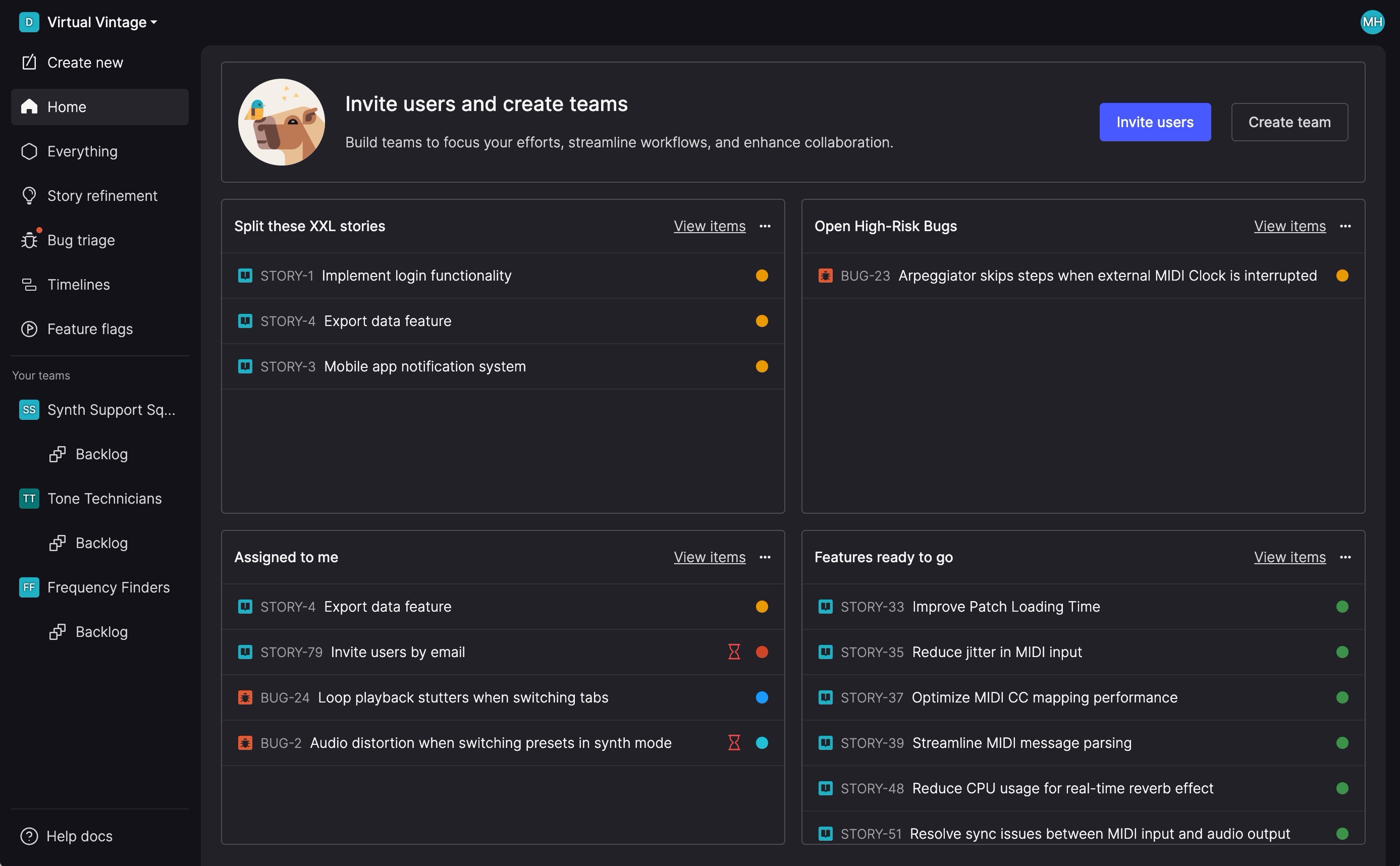
Each row shows the item's type icon, Item ID, and title, with its workflow step icon at the end of the row. If an item has spent much longer in an 'In progress' step than similar items, the row also shows its staleness indicator.
Hover over an item to see more details, including its title, team, assignee, workflow step, and, when they're set, its risk rating (for bugs), product theme, timebox, and size. Click an item to open it.
Each widget shows up to 200 items, which you can scroll through within the widget. To open the full list on the Everything page, click View items. Items on private team backlogs that you can't access are blurred, and you can't open them or see their details.
Assigned to me
The 'Assigned to me' widget shows the stories and bugs assigned to you that are in a workflow step categorized as 'To do' or 'In progress', with the most recently updated items first. Items in 'Done' and 'Won't do' steps aren't included. The widget appears on your Home page by default, and View items opens the 'Assigned to me' view on the Everything page.
Following
The 'Following' widget shows the stories and bugs you're following in any workflow step, so you can keep track of work you care about even when it isn't assigned to you. The most recently updated items appear first, and each row shows how long ago the item was last updated. The widget appears on your Home page by default, and View items opens the 'Following' view on the Everything page.
For more details on following items, see Follow a story or Follow a bug.
Saved and shared view widgets
A widget for a saved or shared view shows the items that match the view's filters, in the same order as the view, and View items opens that view on the Everything page. When the view changes, including when its owner updates a view they've shared with you, the widget updates to match.
The widget is removed from your Home page if the view is deleted, or if you lose access to it because it's no longer shared with you or with a team you're on.
Manage widgets
Your widgets are arranged in two columns, with 'Assigned to me' and 'Following' there by default.
Add a widget
You can add a widget for any saved or shared view from the Everything page. To show a set of items you haven't saved yet, save it as a view on the Everything page first. For more details, see Saved and shared views.
- Hover over the space below your widgets, and click + Add widget.
- Search for or select a view. The list includes:
- 'Assigned to me' and 'Following', if they aren't already on your Home page.
- Views you've saved, under 'My saved views'.
- Views shared with you directly or through a team, under 'Shared with me', with the name of the person who created each one.
Views that already have a widget on your Home page aren't listed. Once every view you have access to has a widget, + Add widget is unavailable, and its tooltip explains why.
Rearrange widgets
To move a widget, click and drag it to a new position on your Home page. The other widgets move to make room.
Remove a widget
- Click the ellipsis (...) icon in the widget's header.
- Select Remove.
- In the confirmation dialog, click Remove widget to confirm, or click X to cancel.
Removing a widget doesn't change or delete its view. To get the widget back, including 'Assigned to me' or 'Following', add it again.
Onboarding
The onboarding panel at the top of your Home page is based on the role you selected when you set up your account, such as 'Product manager' or 'Developer'. This role only decides which videos and tours you see, so it doesn't change what you can do in Atono.
The panel has short videos about key features for your role, and some videos have a Try it button that takes you to the relevant part of Atono. In workspaces that include sample data, the panel also has a 'Learn about Atono' checklist of workflows to try, each of which launches an interactive tour.
Change your role
- In the onboarding panel, click the role next to 'I'm most interested in features for a'.
- Select Product manager, Team lead, Developer, QA engineer, or Other.
The videos and checklist update to match the role you selected.
Dismiss onboarding
You can hide just the checklist or dismiss the whole onboarding panel. Either way, Atono also hides the sample data for you, though other users still see it until they hide it themselves.
- Hide the checklist: Click Hide checklist at the bottom of the checklist. The videos stay on your Home page.
- Dismiss the onboarding panel: Click the X icon in the top-right corner of the panel. This removes both the videos and the checklist.
If your sample data isn't already hidden, click Continue in the confirmation dialog to confirm, or click Cancel.
Bring back onboarding
Once you've hidden the checklist or dismissed the panel, you can restore it from the 'Help' menu in the lower-left corner of Atono.
- Click Help.
- Select Onboarding videos and tours.
- If your sample data is hidden, click Continue in the confirmation dialog to restore it, or click Cancel.
Atono takes you to your Home page, where the onboarding panel and sample data are back.
Sample data
Atono adds sample data when a new workspace is created, so the onboarding tours can show realistic examples without affecting your own work. It includes two sample teams, 'Sample Kanban' and 'Sample Scrum', with example work across Atono.
Sample data is read-only. If you try to delete a sample item, Atono offers to hide all sample data for you instead. Once you've hidden sample data, it no longer appears anywhere you work in Atono, including team backlogs, the Everything page, and Search.
Updated 19 days ago