

Timelines
Align teams and stakeholders with clear delivery timelines.
Timelines in Atono organize timeboxes into a visual schedule, helping teams plan and adjust when stories and bugs are expected to be completed. Instead of a fixed roadmap, timelines reflect actual work in progress, so teams can group related work, shift dates or scope as priorities change, and set expectations with stakeholders, including customers and prospects who want to know when a feature will be available.
Manage timelines
To open the Timelines page, click Timelines in the side menu. The page lists every timeline in your workspace, showing each timeline's name and description, its owner, and when it was last updated. Everyone in the workspace can view, edit, and delete any timeline.
To create and manage the timeboxes that appear on your timelines, click Timeboxes. For more details, see Timeboxes.
Create a timeline
Create separate timelines for different goals, teams, or audiences, so each one shows the plan that matters to them.
- On the Timelines page, click Create timeline.
- In the 'Create timeline' dialog:
- Enter a unique name for your timeline. Special characters like @ { } ' ~ | aren't allowed.
- Optionally, add a description to explain the timeline's purpose.
- Click Create timeline, or click X to cancel.
View your timelines
When your workspace has many timelines, show only the ones you own.
Select the My timelines checkbox above the list. To show all timelines again, clear the checkbox.
Open a timeline
On the Timelines page, click the timeline's name or description.
Edit timeline details
- On the Timelines page, hover over the timeline you want to edit.
- Click the ellipsis (...) icon at the far right of the row.
- Select Edit timeline details.
- In the 'Edit timeline details' dialog, update the timeline's name or description.
- Click Update details, or click X to cancel.
Delete a timeline
- On the Timelines page, hover over the timeline you want to delete.
- Click the ellipsis (...) icon at the far right of the row.
- Select Delete.
- In the confirmation dialog, click Delete timeline to confirm, or click X to cancel.
Deleting a timeline doesn't delete its timeboxes or releases, which stay in your workspace and on any other timelines they appear on.
View a timeline
When you open a timeline, it shows its timeboxes as bars on a calendar, placed according to their start and end dates. Releases appear as markers along the top of the timeline, and a highlighted line marks today's date. By default, the timeline shows the current quarter, but you can scroll and zoom to change the view.
Each timebox shows its name and, depending on its height, more details:
- The number of stories and bugs in the timebox.
- The product themes associated with its items.
- The teams whose backlogs its items belong to.
- The total story points, in parentheses after the name, when every story and bug in the timebox is on the same team’s backlog.
- A warning indicator when the timebox includes work that may not be completed by its end date.

Filtering, scrolling, and zooming only change your own view of the timeline. Other changes, such as adjusting timebox height or changing a timebox's color, are visible to everyone viewing the timeline.
Filter timeboxes
Show only the timeboxes that include items from particular teams or product themes.
- Click the filter (funnel) icon next to 'Filter by' at the top of the timeline.
- Select a filter, or search for one, and fill in any required details.
- Click Apply.
- Repeat steps 1 to 3 to add more filters.
The timeline shows only the timeboxes that match all your filters, and each filter appears as a pill next to 'Filter by'.
Modify a filter value
- Click the filter pill next to 'Filter by'.
- Change its value, then click Apply.
Remove a filter
Click the X on the filter pill.
Available filters
Filters are listed in the same order as the menu.
| Filter | Description |
|---|---|
| Team | View timeboxes that include items on the selected teams' backlogs, or items with 'No team'. |
| Product theme | View timeboxes that include items assigned to particular product themes, or items with 'No product theme'. |
Scroll through the timeline
You can move around the timeline in several ways:
- Horizontally: Drag the timeline, or swipe on a mouse or trackpad.
- Vertically: Use a mouse wheel, or swipe on a mouse or trackpad, to move through the timeboxes.
- Return to today: Click the calendar icon, which shows today's date, at the top right of the timeline.
Adjust timebox height
Changing a timebox's height affects everyone's view of the timeline.
To show more or less detail in a timebox:
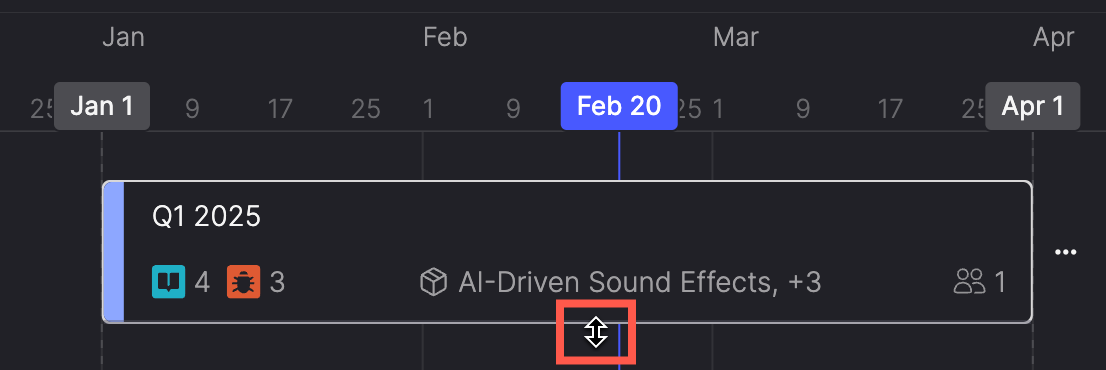
- Adjust a single timebox: Hover over its bottom border. When the resize handle appears, drag to make the timebox taller (up to 3 lines) or shorter.
- Adjust all timeboxes: Use the height controls at the bottom left of the timeline to set every timebox to 1, 2, or 3 lines.
Adjust zoom levels
Zoom in to focus on a span as short as 2 days, or zoom out to see up to 5 years at once. To change the zoom level, do any of the following:
- Pinch on a trackpad.
- Scroll with the mouse wheel while holding Ctrl (Windows) or Command (Mac).
- Use the zoom controls at the bottom right of the timeline: click the zoom out (-) or zoom in (+) icon, or drag the slider between them.
Atono remembers your zoom level for each timeline.
Use timeboxes
For more details about creating timeboxes, managing their items, and reviewing item-level warnings, see Timeboxes.
Add a timebox to the timeline
Add an existing timebox or create one
- At the top of the timeline, click Add timebox.
- Do one of the following:
- Search for or select an existing timebox.
- Click + Create a new timebox and fill in the required information. For details, see Create a timebox.
Add a timebox by double-clicking
Double-click an empty spot on the timeline at the date where you want the timebox to start. Atono creates a timebox that starts on that date and ends two weeks later, in the row closest to where you clicked. Its name is selected so you can rename it right away.
View items in a timebox
Hover over the story or bug icon in a timebox to preview its items, including each item's Item ID, title, and current workflow step.
To see all the items in a timebox, and their total story points when they all belong to one team, open the timebox. For more details, see View a timebox.
View associated product themes
Hover over the product theme icon in a timebox to see its associated product themes. A timebox's themes come from the stories in it. For more details, see Product themes.
View associated teams
Hover over the team icon in a timebox to see the teams associated with it. A team is associated with a timebox when items in the timebox are on its backlog.
Identify timeboxes with warnings
When a timebox includes at least one story or bug with a warning, a warning indicator appears in the timebox's top right corner. This means some of the work in the timebox may not be completed before its end date.

Warning indicators only appear on timeboxes that end within the next 90 days, so timeboxes further out stay flexible for planning.
Why a timebox may show a warning
A timebox shows a warning when it includes, for example:
- Items that aren't assigned to a team.
- Items projected to finish after the timebox's end date.
- Items on a Scrum team's backlog that aren't assigned to a sprint.
To see which items are affected and why, open the timebox. For more details, see Identify items with warnings and Projected to finish after the timebox.
Change a timebox's dates
Changing a timebox's dates changes them everywhere the timebox is used.
Do one of the following:
- To move the timebox, drag it left or right along the timeline. Its start and end dates move together.
- To change its start or end date, drag its left or right edge.
You can also change a timebox's dates from its details page. For more details, see View a timebox.
Open a timebox
Do one of the following:
- Double-click the timebox.
- Hover over the timebox, click the ellipsis (...) icon next to it, and select View timebox.
You can also open a timebox from the Timeboxes page or from a story or bug. For more details, see Open a timebox.
Rename a timebox
Renaming a timebox changes its name everywhere the timebox is used.
- Hover over the timebox.
- Click the ellipsis (...) icon next to the timebox and select Rename timebox.
- The timebox's name becomes editable. Type the new name, then press Enter or click outside the name to save it.
You can also rename a timebox from its details page. For more details, see Edit timebox details.
Change a timebox's color
Changing a timebox's color is visible to everyone viewing the timeline.
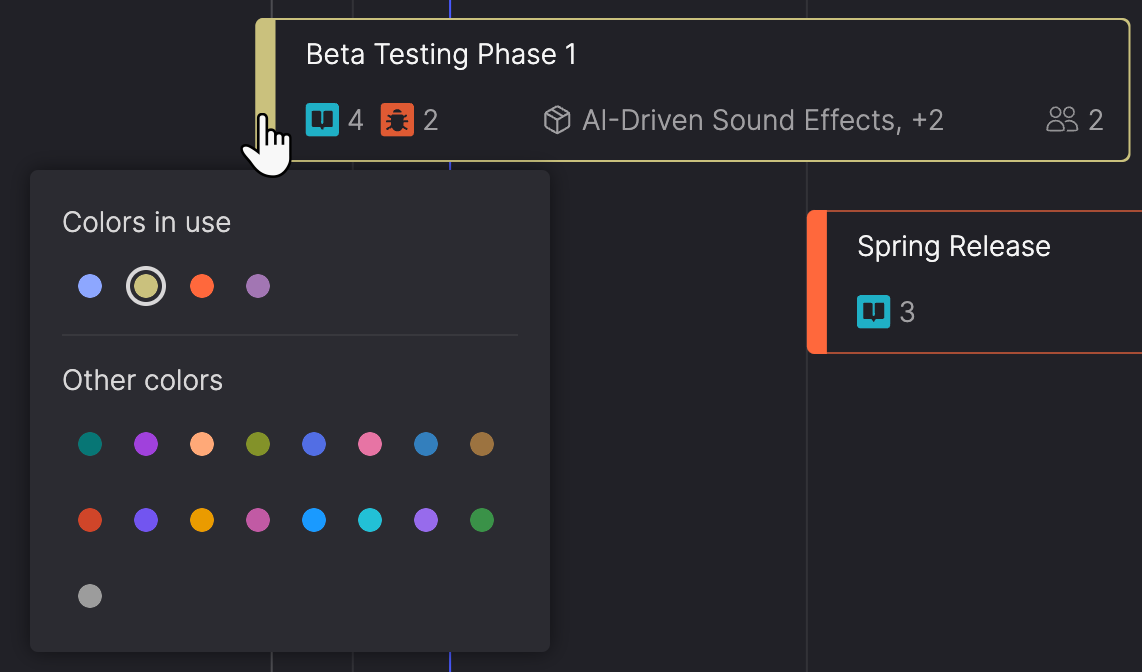
Atono assigns each timebox a default color, but you can change it to make a timebox stand out or to group related timeboxes visually.
- Hover over the timebox.
- Do one of the following:
- Click the ellipsis (...) icon next to the timebox and select Change color.
- Click the colored edge of the timebox.
- Select a new color, or select one from the palette of colors already in use.
Remove a timebox from a timeline
- Hover over the timebox.
- Click the ellipsis (...) icon next to the timebox and select Remove from timeline.
- In the confirmation dialog, click Remove timebox to confirm, or click X to cancel.
The timebox isn't deleted, and it stays on any other timelines it appears on. If it has no stories or bugs and isn't on any other timeline, a second dialog asks whether you want to delete it. Click Delete timebox to delete it, or click Skip to keep it.
Use releases
Releases mark key dates, such as launch dates or feature flag flips, so you can line work up with them across product, marketing, and engineering. Each release appears as a marker along the top of the timeline, labeled with its date and name, with a vertical line that spans the whole timeline.
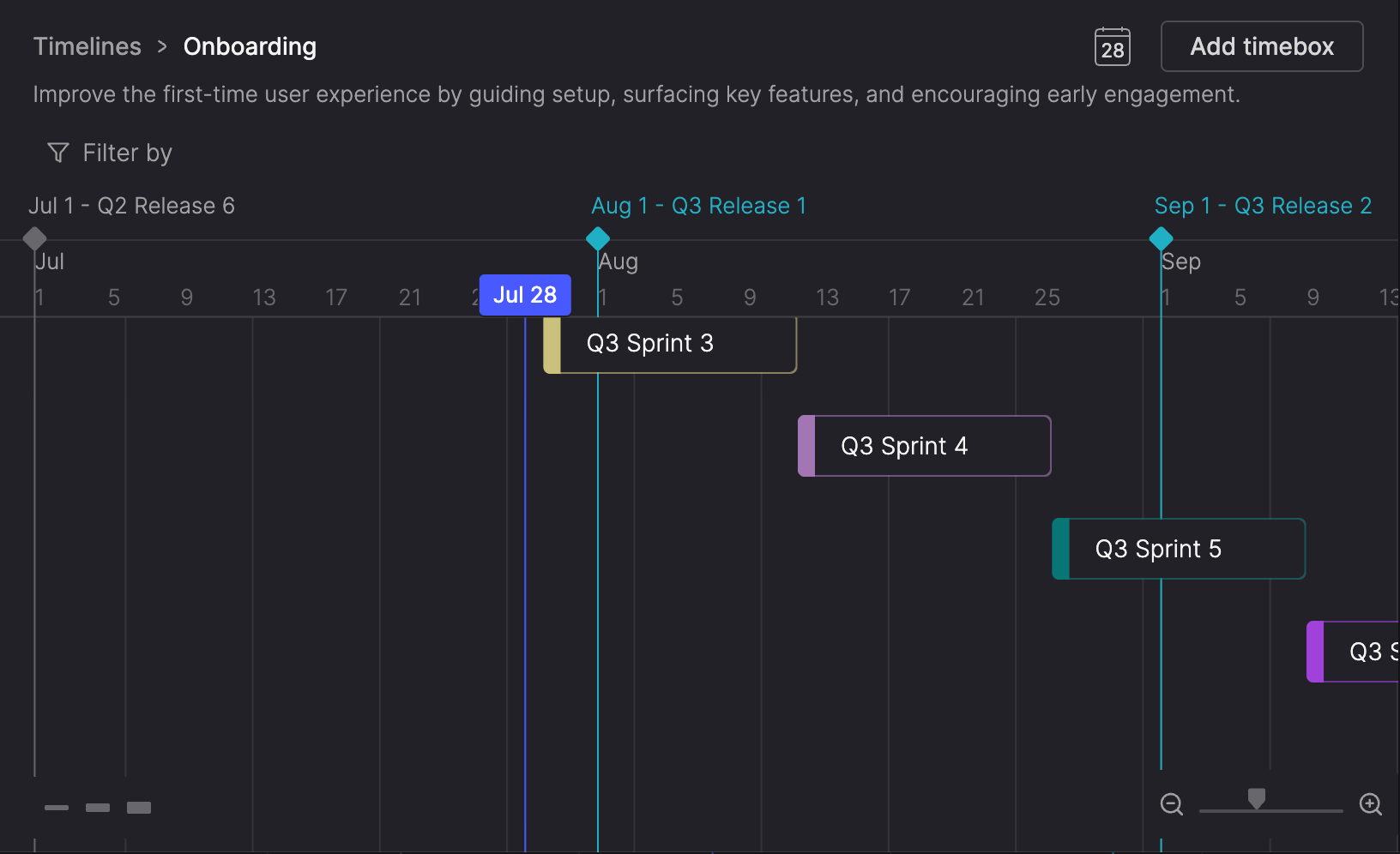
Releases are shared across your workspace, so the same release can appear on several timelines and team backlogs. To add one to a timeline, click Add release to select existing releases or create a new one, or hover over the top of the timeline and click the plus (+) icon. To change a release's date, drag it along the timeline. To edit, remove, or delete it, right-click it.
For more details, see Releases.
Updated 9 days ago